Professor, Division Chief, Program Director University of Toledo PM&R Program Toledo, Ohio
Disclosure(s):
Tyler Freeman, MD: No financial relationships to disclose
Case Diagnosis: Avulsion Fracture of T1 Spinous Process.
Case Description or Program Description: A 24-year-old male presented with a 4-day history of acute upper thoracic spine pain following a golf swing. He described experiencing a “popping” sensation in his spine at the time of the injury. The patient reported radiating pain to the rib cage and periscapular regions bilaterally. He also noted difficulty lifting his arms overhead.
Setting: Academic Medical Center
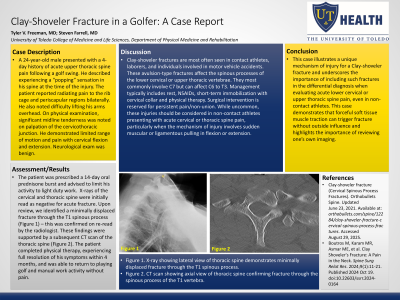
Assessment/Results: On physical examination, significant midline tenderness was noted on palpation of the upper thoracic region. He demonstrated limited range of motion and pain with cervical flexion and extension. Deep tendon reflexes were symmetric and normal, and no upper motor neuron signs were observed. The patient was prescribed a 14-day oral prednisone burst and advised to limit his activity to light duty work. X-rays of the cervical and thoracic spine revealed a minimally displaced fracture through the T1 spinous process. These findings were confirmed by a CT scan of the thoracic spine. The patient completed physical therapy, experiencing full resolution of his symptoms within 4 months, and returned to playing golf and performing manual work without pain.
Discussion (relevance): Clay-shoveler fractures are most often seen in contact athletes, laborers, and individuals involved in motor vehicle accidents. These avulsion-type fractures affect the spinous processes of the lower cervical or upper thoracic vertebrae. While uncommon, these injuries should be considered in non-contact athletes presenting with acute cervical or thoracic spine pain, particularly when the mechanism of injury involves sudden muscular or ligamentous pulling in flexion or extension.
Conclusions: This case illustrates a unique mechanism of injury for a Clay-shoveler fracture and underscores the importance of including such fractures in the differential diagnosis when evaluating acute lower cervical or upper thoracic spine pain, even in non-contact athletes. It demonstrates that forceful soft tissue muscle traction can trigger a fracture without outside influence.

.jpg)