Staff physician VA Palo Alto Los Gatos, California
Disclosure(s):
Bonnie Lui, MD: No financial relationships to disclose
Brittni Micham, MD: No financial relationships to disclose
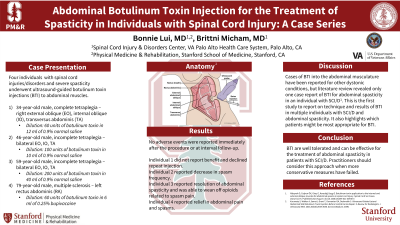
Case Diagnosis: Three individuals with spinal cord injury (SCI) and severe spasticity underwent ultrasound-guided botulinum toxin injections (BTI) to abdominal muscles.
Case Description or Program Description: A 34-year-old male with complete tetraplegia suffered autonomic dysreflexia due to poor ileal conduit drainage caused by abdominal spasms. He underwent BTI into the right external oblique (EO), internal oblique (IO), and transversus abdominis (TA). A 46-year-old male with incomplete tetraplegia similarly experienced abdominal spasms near his ileovesicostomy resulting in poor urinary drainage. He underwent BTI into the bilateral EO, IO and TA. A 59-year-old male with incomplete tetraplegia suffered from severe abdominal spasticity refractory to multiple oral antispasmodics, eventually leading to illicit opioid use for relief. He underwent BTI into the bilateral EO, IO and TA. Each set of BTIs was done under ultrasound guidance.
Setting: Tertiary Care Hospital
Assessment/Results: No adverse events were reported immediately following the procedures or at interval follow up. The 34-year-old male did not report benefit and declined repeat injection. The 46-year-old male reported decrease in spasm frequency. The 59-year-old male reported resolution of abdominal spasticity and was able to eventually wean off illicit opioids.
Discussion (relevance): Cases of BTI into the abdominal musculature have been reported for other dystonic conditions, but literature review revealed only one case report of BTI for abdominal spasticity in an individual with SCI. This is the first study to report on technique and results of BTI in multiple individuals with SCI and abdominal spasticity. It also highlights which patients might be most appropriate for this intervention.
Conclusions: BTI are well tolerated and can be effective for the treatment of abdominal spasticity in patients with SCI. Practitioners should consider this approach when more conservative measures have failed.

.jpg)