Clinical Associate Professor Hofstra Northwell School of Medicine PM&R Program Great Neck, New York
Disclosure(s):
Muhammad U. Ahmed, Other: No financial relationships to disclose
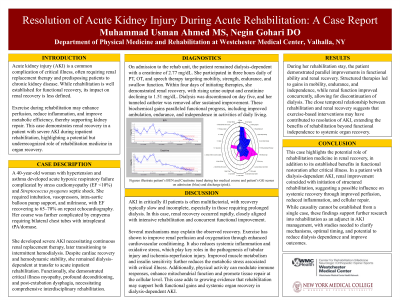
Case Diagnosis: A 40-year-old female with a past medical history of asthma and hypertension developed acute kidney injury (AKI) necessitating renal replacement therapy (RRT) subsequent to cardiogenic shock, septic shock due to group A Streptococcus bacteremia, and severe left ventricular dysfunction.
Case Description or Program Description: The patient presented with acute hypoxic respiratory failure and received treatment including an intra-aortic balloon pump (IABP), mechanical ventilation, chest tube placement for bilateral empyema, and broad-spectrum antibiotics. She required continuous veno-venous hemodialysis (CVVHD), subsequently transitioning to intermittent hemodialysis (iHD). Persistent AKI required ongoing dialysis at the time of discharge to acute inpatient rehabilitation.
Setting: She was transferred to acute inpatient rehabilitation for significant deconditioning, critical illness myopathy, and post-extubation dysphagia. Therapy comprised three hours of daily physical, occupational, and speech therapy aimed at improving mobility, strength, endurance, and swallow.
Assessment/Results: Upon initiation of her rehabilitation course, the patient exhibited improved endurance, ambulation and functional independence. Simultaneously, the patient had renal recovery with increase in her urine output and decrease in serum creatinine from 2.77 mg/dL to 1.51 mg/dL within four days of her rehabilitation admission. By day five, dialysis was discontinued, and her tunneled catheter was removed following confirmation of renal recovery.
Discussion (relevance): Renal recovery coincided with structured rehabilitation, suggesting that exercise may serve as a potential therapeutic factor in AKI resolution. Possible mechanisms include improved renal perfusion, reduced systemic inflammation, improved muscle metabolism, and modulation of the immune system. Exercise has demonstrated the capability to reduce oxidative stress, improve mitochondrial function, and promote renal tissue repair, supporting AKI recovery.
Conclusions: This case emphasizes the significance of rehabilitation medicine in the recovery from AKI, illustrating a correlation between functional improvement and biochemical markers of renal function. Additional research is necessary to investigate exercise-based rehabilitation as a potential therapeutic approach for the resolution of AKI in critically ill patients.

.jpg)