Assistant Professor Kennedy Krieger Institute Baltimore, Maryland
Disclosure(s):
Kristen Courtney, DO: No financial relationships to disclose
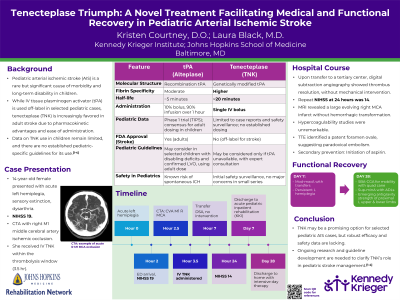
Case Diagnosis: A 14-year-old female presented with acute left hemiplegia secondary to an ischemic right M1 MCA stroke, likely due to paradoxical embolism.
Case Description or Program Description: The patient developed acute-onset left hemiplegia, extinction, and dysarthria, with a CT angiogram showing intramural thrombus in the mid-portion of the right M1 MCA. Initial NIHSS was 19. She was within the thrombolysis window (3.5 hours) and received tenecteplase (TNK). On transfer to a tertiary hospital, DSA showed thrombus resolution without mechanical intervention required. Repeat NIHSS score at 24 hours was 14. MRI revealed an evolving, large right MCA infarct, without hemorrhagic transformation.
Assessment/Results: The patient’s hypercoagulability workup was unremarkable. Transthoracic echocardiogram revealed a PFO, suggesting paradoxical cardioembolism within the stroke etiology. She was started on aspirin for secondary stroke prevention. On hospital day 7, she required moderate-maximum assistance with transfers due to persistent hemiplegia. After 3 weeks of inpatient rehabilitation, she had made significant functional progress, requiring only standby-contact guard assistance for mobility with a quad cane, supervision-minimal assistance with ADLs, and emerging antigravity strength of her proximal left upper and lower limbs. She then pursued further therapy with an intensive day rehabilitation program to maximize functional recovery and improve ambulation.
Discussion (relevance): TNK is increasingly used for thrombolysis in acute ischemic stroke, primarily in adults, as its use in pediatric arterial ischemic stroke (AIS) is not only off-label, but also limited from knowledge gaps in safety and efficacy. Literature review identified approximately 11 unique cases of TNK use in suspected pediatric AIS. Our patient showed thrombus resolution and a 5-point, 24-hour improvement in NIHSS after TNK administration, with notable functional progress.
Conclusions: TNK administration in pediatric AIS, though limited in data, may show beneficial outcomes with thrombus resolution and improved functional recovery; especially, in combination with early, intensive neurorehabilitation, supporting further investigation into its potential.

.jpg)