Resident University of Arkansas for Medical Sciences PM&R Program Little Rock, Arkansas
Disclosure(s):
Kamaria Coleman, MD: No financial relationships to disclose
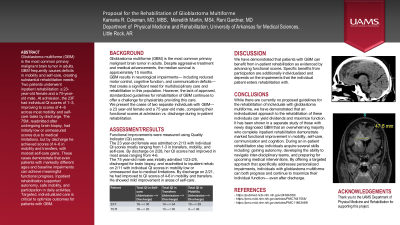
Background and/or Objectives: Glioblastoma multiforme, the most common primary malignant brain tumor, continues to offer a rehabilatory challenge for physiatrists. There remain several challenges in the rehabilitation of glioblastoma multiforme, notably a lack of approved guidelines for rehabilitation of this condition. Below, we present 3 separate cases of glioblastoma multiforme as potential approaches for the rehabilitation of this devastating condition.
Design: Comparing the rehabilitation of 3 separate individuals with glioblastoma multiforme, we present a potential approach for rehabilitation of the condition.
Setting : In-patient rehabilitation
Participants : We compared the admission and discharge functional score of three individuals with glioblastoma multiforme including: a 23 year old female, a 56 year old male and a 63 year old male.
Interventions: Participation in in-patient rehabilitation and addressing any acute medical issues experienced during in-patient rehabilitation.
Main Outcome Measures: Admission and discharge functional scores.
Results: We have demonstrated that patients with glioblastoma multiforme can benefit from in-patient rehabilitation as evidenced by advancing functional scores. Specific benefits from participation are additionally individualized and depends on the impairments that the individual patient enters rehabilitation with.
Conclusions: While there are currently no proposed guidelines for the rehabilitation of individuals with glioblastoma multiforme, we have demonstrated that an individualized approach to the rehabilitation of these individuals can yield dividends and maximize function. During an in-patient rehabilitation stay individuals acquire several skills including: gaining autonomy, developing the ability to navigate inter-disciplinary teams, and preparing for upcoming medical interventions. By offering a targeted approach that specifically addresses personalized impairments, individuals with glioblastoma multiforme can both progress and continue to maximize their individual function-even after discharge

.jpg)