Medical Director San Mateo Spine Center San Mateo, California
Disclosure(s):
Yung C. Chen, MD: No financial relationships to disclose
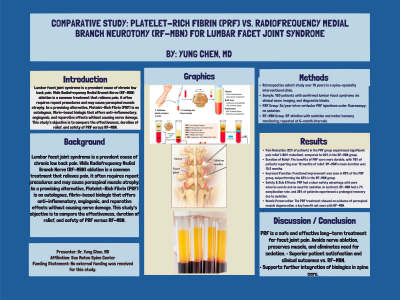
Case Diagnosis: Assessing the comparative effectiveness, duration of pain relief, and safety of PRF injections versus RF-MBN in managing chronic lumbar facet joint syndrome
Case Description or Program Description: This study evaluates the efficacy and safety of PRF in comparison to RF-MBN for lumbar facet joint syndrome.
Setting: A retrospective cohort analysis of 160 patients diagnosed with chronic axial facet joint-mediated spine pain over a 10-year period, conducted at a specialized interventional spine pain management center.
Assessment/Results: 12-month follow-up, 82% of PRF patients reported significant pain reduction (>80% decrease in VAS) compared to 60% in the RF-MBN cohort. PRF provided pain relief exceeding 12 months in 78% of patients, RF-MBN required repeat procedures after a mean of 10.2 months ODI scores showed substantial improvement in the PRF group (85% of patients) compared to the RF-MBN group (65%). No instances of paraspinal muscle degeneration were observed in the PRF cohort, mitigating concerns of spinal instability associated with RF ablation
Discussion (relevance): The findings of this study reinforce the growing body of evidence favoring PRF as an effective alternative to RF-MBN for lumbar facet joint syndrome. PRF’s capacity to deliver sustained analgesia without neural compromise or paraspinal muscle atrophy underscores its therapeutic superiority.
Conclusions: Unlike RF-MBN, PRF preserves paraspinal muscle integrity, circumventing the risk of spinal instability. These findings position PRF as a promising alternative therapy, meriting further investigation into its mechanisms and potential applications in interventional pain management

.jpg)