Medical Student Saint Louis University School of Medicine Northbrook, Illinois
Disclosure(s):
William Kardasis, Other: No financial relationships to disclose
Background and/or Objectives: Patients who had a reverse shoulder arthroplasty undergo physical therapy (PT) after to achieve optimal outcomes. Two recent randomized controlled trials did not show differences in patient range of motion or patient-reported outcomes when comparing formal PT programs to home-based programs. Nonetheless, it is unclear if patients prefer a certain PT method.
Design: The study was a cross-sectional survey. A priori power analysis determined that for a 15% difference in preference rates, 80 patients/group were needed.
Setting : Remote.
Participants : 160 patients who underwent a reverse shoulder arthroplasty 1-5 years prior to the study in the St. Louis area. 82 patients (51%) were female, with an average age of 70.8 ± 8.5 years and a BMI of 31.75 ± 6.1 kg/m². The procedure was most commonly done for cuff arthropathy or primary osteoarthritis.
Interventions: Chart review was performed to identify patient demographics, indication for surgery, ROM, complications. Patients were contacted via phone to complete a survey regarding their perception and preference for PT after surgery.
Main Outcome Measures: Agreement or disagreement with statements regarding patient preference for physical therapy (home or clinic) was measured on a 1-5 scale, with 1 being strongly disagree and 5 being strongly agree.
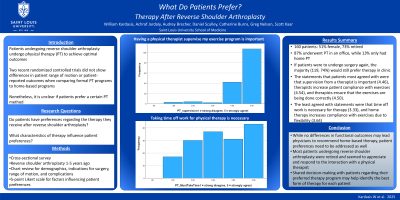
Results: Most patients (139, 87%) underwent PT in the clinic. If patients were to undergo surgery again, the majority (119, 74%) would still prefer therapy in the clinic. The statements that patients most agreed with were that supervision from a therapist is important (4.46), therapists increase patient compliance with exercises (4.54), and therapists ensure that the exercises are being done correctly (4.50). The least agreed-with statements were that time off work is necessary for therapy (3.33), and home therapy increases compliance with exercises due to flexibility (3.64).
Conclusions: Most patients in this study preferred clinic-based PT, but individual patient preferences should still be addressed through shared decision-making.

.jpg)