Assistant Professor Burke/AECOM Bellmore, New York
Disclosure(s):
Clayton Mucha, DO: No financial relationships to disclose
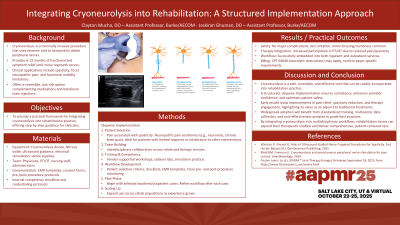
Case Diagnosis: Implementation of a cryoneurolysis service in a rehabilitation setting for patients with spasticity and chronic pain.
Case Description or Program Description: Cryoneurolysis is a minimally invasive technique that applies controlled cold to peripheral nerves, reducing pain and stiffness associated with spasticity and improving mobility. It has been used to manage post-stroke spasticity, cerebral palsy, multiple sclerosis, chronic musculoskeletal pain, and neuropathic pain. Despite its benefits, structured guidelines for implementation in a rehabilitation setting are lacking. This study outlines a framework for establishing a cryoneurolysis service, addressing patient selection, procedural workflow, safety measures, and financial considerations.
Setting: Rehabilitation and pain management clinics integrating cryoneurolysis into treatment protocols.
Assessment/Results: Implementation of the service led to optimized patient selection, improved procedural efficiency, enhanced provider confidence, and streamlined billing. Preliminary data indicates high patient satisfaction, improved mobility, reduced pain, and positive functional outcomes. Functional assessments included range of motion, ADL independence, and validated pain scales. Follow-ups tracked symptom relief durability, patient satisfaction, and the need for reapplication.
Discussion (relevance): Cryoneurolysis offers a novel approach to managing pain and spasticity in rehabilitation patients, providing an alternative to more invasive procedures. By incorporating cryoneurolysis into existing rehabilitation protocols, clinics can expand treatment options for patients with chronic pain and neuromuscular conditions. Further research is needed to assess long-term outcomes and cost-effectiveness, but early findings suggest significant benefits for both patients and providers.
Conclusions: A structured cryoneurolysis service can enhance pain relief, mobility, and functional independence in rehabilitation patients. Establishing standardized protocols for patient selection, procedural execution, and follow-up care is essential for optimizing treatment outcomes. Future studies should explore the long-term impact and broader clinical applications of cryoneurolysis.

.jpg)