Resident University of Arkansas for Medical Sciences PM&R Program Little Rock, Arkansas
Disclosure(s):
Kamaria Coleman, MD: No financial relationships to disclose
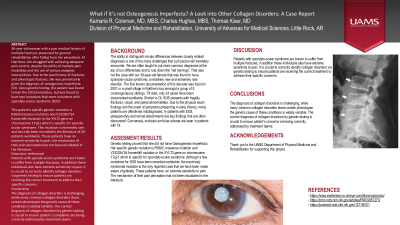
Case Diagnosis: 36 year old woman was mis-diagnosed with Osteogenesis Imperfecta and found to have the only known reported mutation of R563C missense mutation and V232Gfs*54 frameshift mutation in the XYLT2 gene on chromosome 17q21 which is specific for spondo-ocular syndrome.
Case Description or Program Description: This 36 year old woman presented for general rehabilitation after falling from her wheelchair. During her rehabilitation stay she struggled with pain despite the utility of multimodal pain control and the use of various pain modalities. She had a prior history of multiple fractures and phenotypic features of osteogenesis imperfecta.
Setting: In-patient rehabilitation
Assessment/Results: Genetic testing proved that she did not have Osteogenesis Imperfecta. Her specific genetic mutation is R563C missense mutation and V232Gfs*54 frameshift mutation in the XYLT2 gene on chromosome 17q21 which is specific for spondo-ocular syndrome. This mutation is extremely rare and has only been recorded in the literature of 20 patients worldwide. These patients have an extreme sensitivity to pain. the mechanism of their pain perception has not been elucidated in the literature.
Discussion (relevance): Patients with spondo-ocular syndrome are known to suffer from multiple fractures, in addition these individuals also have extreme sensitivity to pain. It is crucial to correctly identify collagen disorders via genetic testing to ensure patients are receiving the correct treatment to address their specific concerns.
Conclusions: The diagnosis of collagen disorders is challenging, while many common collagen disorders share certain phenotypes the genetic cause of these conditions is widely variable. The correct diagnosis of collagen disorders by genetic testing is crucial to ensure patient's complaints are being correctly addressed by treatment teams.

.jpg)